LEADS
Lightweight Embedded Assisted Driving System



With the rapid development of electric vehicles, formula races that face high school and university students have become more popular than ever as the threshold for design and manufacturing has been lowered. In many cases, we see teams inspired by or directly using toolkits and technologies inherited from standardized commercial vehicles. These architectures are usually overly complicated for amateur applications like the races. In order to improve the efficiency and simplify the development of instrumentation, control, and analysis systems, we propose LEADS (Lightweight Embedded Assisted Driving System), a dedicated solution for such scenarios (Fu et al., 2024).
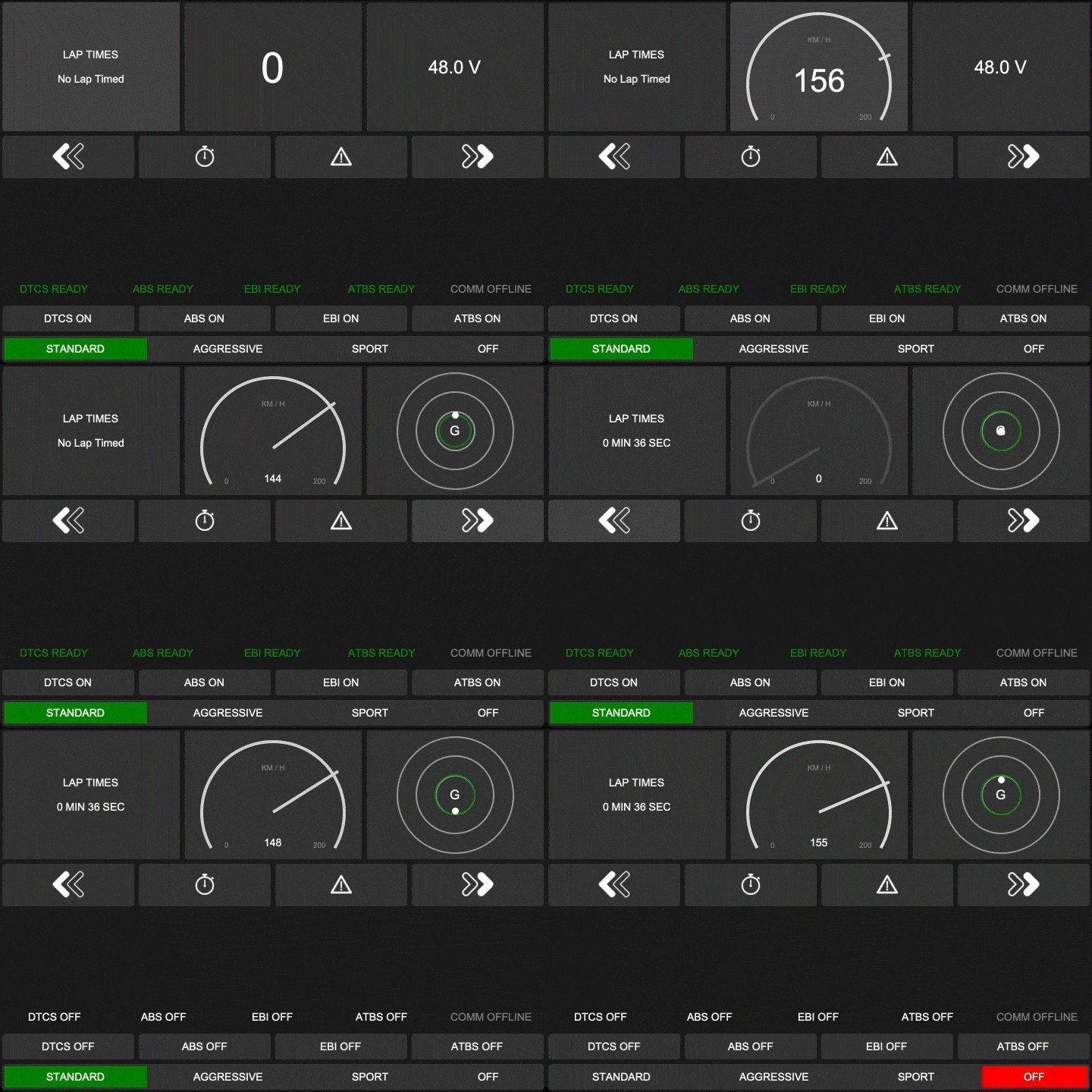
LEADS is a lightweight embedded assisted driving system. It is designed to simplify the development of instrumentation, control, and analysis systems for racing cars. It is written in well-organized Python and C/C++ and has impressive performance. It is not only out-of-the-box but also fully customizable. It provides multiple abstract layers that allow users to pull out the components and rearrange them into a new project. You can either configure the existing executable modules (LEADS VeC) simply through a JSON file or write your own codes based on the framework as easily as building a LEGO.
The hardware components chosen for this project are geared towards amateur developers. It uses neither a CAN bus (although it is supported) nor any dedicated circuit board, but generic development kits such as Raspberry Pi and Arduino instead. However, as it is a high-level system running on a host computer, the software framework has the ability to adapt to any type of hardware component with extra effort.